


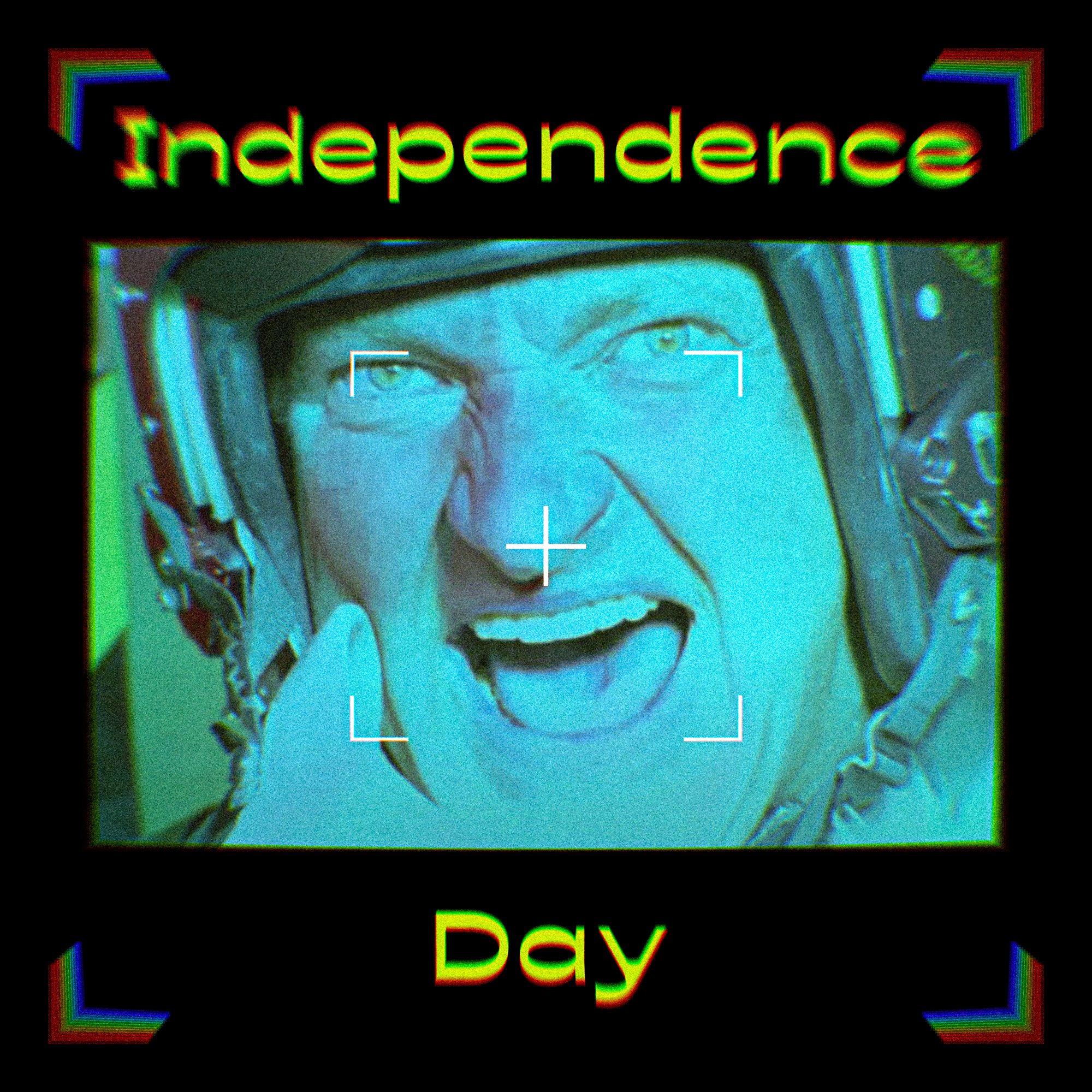
Van and Lyle are joined by critically acclaimed actor Morgan Spector to revisit Roland Emmerich’s Independence Day, a film that turns planetary annihilation into a distinctly American spectacle. We spend time lingering on the movie as a shared artifact of a particular 1990s childhood. The Ray Charles warmth of its opening, the awe of its destruction sequences, and, of course, the internalization of President Whitmore’s speech—“Today, we celebrate our Independence Day!”—memorized and recited by every other boy of that era. It opens, tellingly, on the American flag planted on the moon, Neil Armstrong’s voice echoing as if the “giant leap for mankind” had always been a national possession. When the aliens arrive, they don’t just threaten Earth but a worldview in which the United States stands in for humanity itself.
What follows is less a global response than a convergence of American archetypes: The cocky Marine pilot, the underachieving Jewish technologist, the cowboy president who ultimately climbs into a jet and leads the counterattack himself. Morgan helps us think through both the appeal and limits of that fantasy. How the film captures a moment of post–Cold War confidence where disparate social types could be harmonized into national purpose. Even the technological imagination reflects that era. The aliens are defeated not through overwhelming force, but through a computer virus delivered via laptop, a pre-Internet-age fantasy of improvisation and ingenuity. We debate the film’s politics in this spirit—what’s explicit, unconscious, or just ambient—and how something that feels so unifying and fun can also encode a very particular vision of indispensability.
One of Morgan’s sharpest observations centers on Randy Quaid’s Russell Casse, the traumatized Vietnam vet turned conspiracy crank who ultimately redeems himself through a kamikaze sacrifice. And for being right in the end. The film doesn’t just tolerate him; it elevates him. That kind of crankiness, Morgan argues, was once legible, even lovable. Something you could live alongside, maybe even learn from. In a relatively stable, “post-historical” moment for the American middle class, the stakes felt low enough to allow for that kind of messy tolerance. Today, that figure reads differently. Less endearing, more dangerous, harder to absorb into a shared project. Independence Day ends with fireworks, but what lingers is something quieter. Namely, a memory of a world where you could still believe that everyone had a place in the story.
Further Reading
Morgan on American Prestige (The Nation)
Morgan’s Illustrious Wiki Page
“A Bad Breakup” (review of Fukuyama) by Danny Bessner
The End of Victory Culture by Tom Engelhardt
Marine Corps Air Station El Toro


