



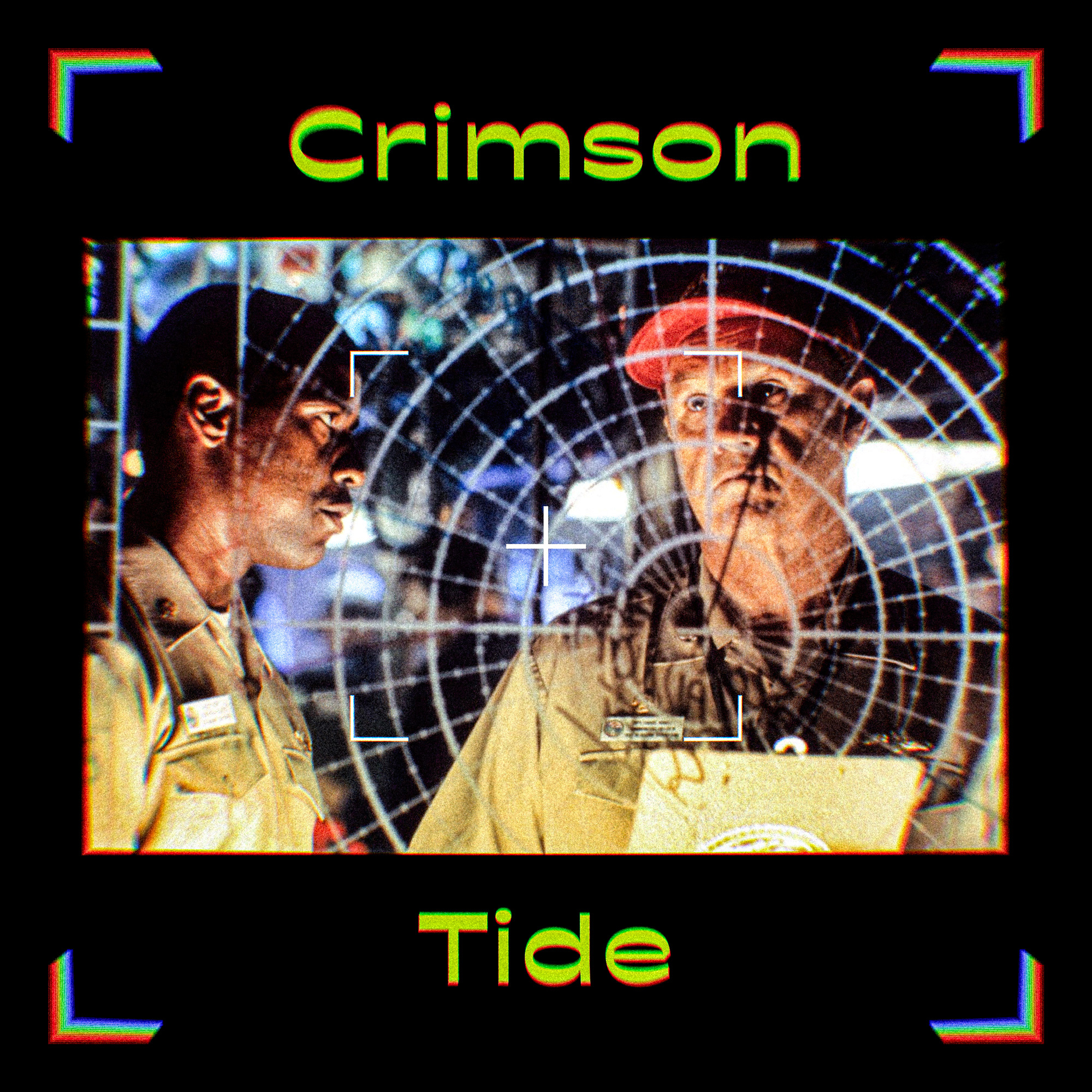
Van and Lyle welcome back Andy Facini, Communications Director at the Council on Strategic Risks, to take on Tony Scott’s Crimson Tide. Gene Hackman’s Captain Ramsey and Denzel Washington’s Lt. Commander Hunter are locked inside an Ohio-class ballistic missile submarine with enough firepower to end civilization, and the film turns their standoff into a test of everything the nuclear age is supposed to rest on: Chain of command, verified orders, rational actors.
Andy brings firsthand knowledge of the submarine world and walks us through what the film gets right about the culture and protocols, as well as what it stretches. The argument arrives early, over dinner, when Ramsey presses Hunter on Hiroshima and the two debate Clausewitz. “In the nuclear world, the true enemy is war itself,” Hunter declares. Ramsey, cigar in hand, calls himself a “simple-minded son of a bitch” and suggests the Navy wants both types. But the film’s own logic, and ours, pushes back. You don’t need the psychopath, you just need the one who thinks.
Still, Crimson Tide is smarter than a clean binary, and that’s also its problem. Ramsey is too charismatic, too commanding, and ultimately too generous, recommending Hunter for full command and conceding on the Lipizzaner stallions, to be reducible to villain. The warmth of Hackman’s performance softens a position that, followed to its conclusion, would have killed millions. Meanwhile the racial subtext hums underneath. Denzel’s Hunter is the “complicated one,” the Harvard-educated Black officer navigating a white institution, and those stallions “born black” but turning white barely qualify as metaphor. Produced by Jerry Bruckheimer, scored by Hans Zimmer, and directed with Tony Scott’s signature controlled chaos, the film stages every radio crackle and depth reading with the intensity of a firefight. “We’re here to preserve democracy, not to practice it,” Ramsey tells his crew.
Released amid post-Cold War anxieties about Russian instability, Crimson Tide imagines nuclear catastrophe not as ideological failure but as crossing a thin line between procedural discipline and annihilatory madness; a garbled message, a broken radio, a system that works more or less as designed, always on the verge of destroying the world.
Further Reading, Listening, Viewing
Bang-Bang’s WarGames episode w/ Sam Ratner and Andy Facini
Viggo Mortensen on Charlie Rose
Command and Control: Nuclear Weapons, the Damascus Accident, and the Illusion of Safety by Eric Schlosser
Thermonuclear Monarchy: Choosing Between Democracy and Doom by Elaine Scarry
Teaser from the Episode
Crimson Tide Trailer


