



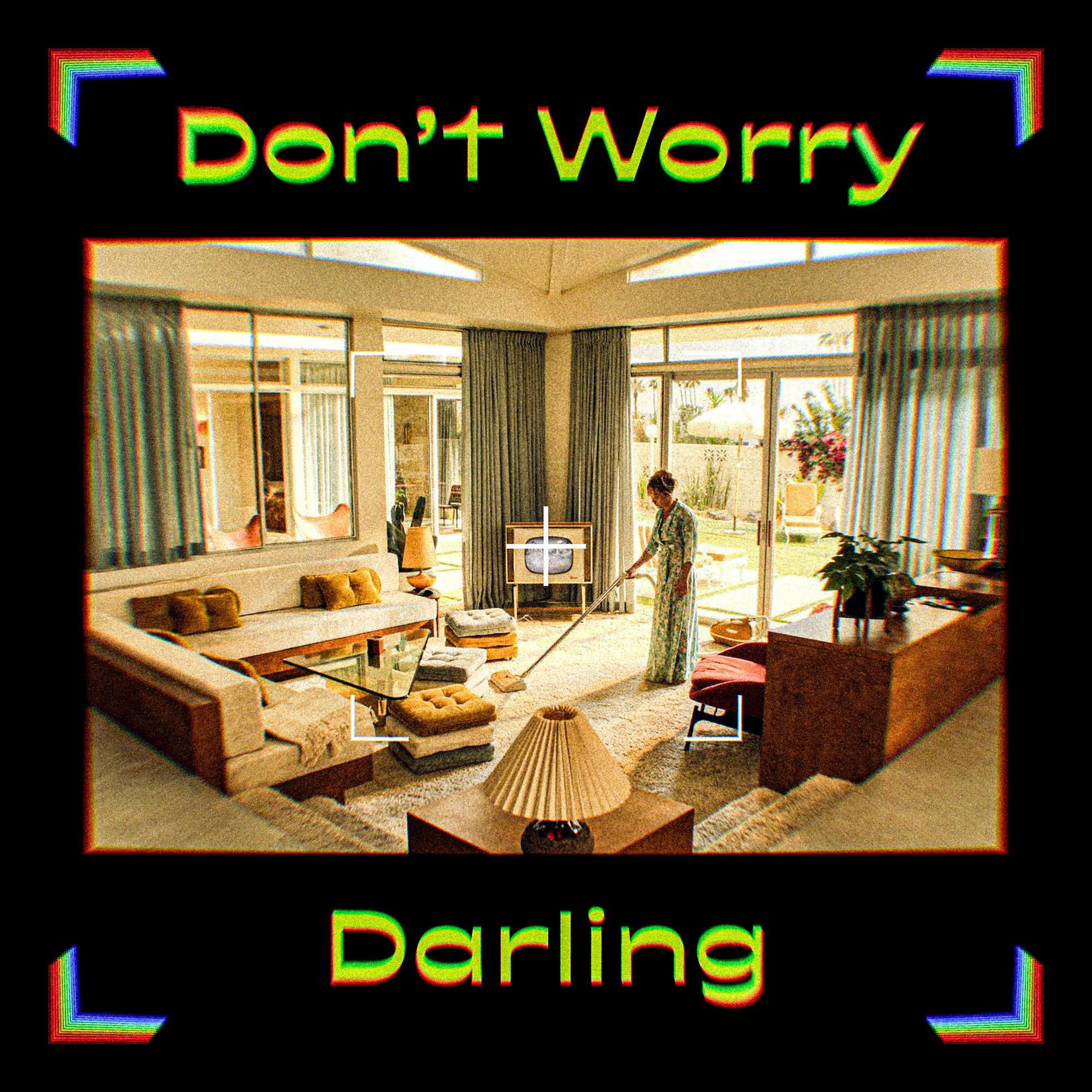
Van and Lyle are joined by Julia Gledhill (of The Un-Diplomatic Podcast and Stimson Center fame) to revisit Olivia Wilde’s Don’t Worry, Darling, a film dismissed by many critics as a glossy pastiche but better understood as a deliberate medley of American ideological fantasies. Set in the manicured desert enclave of the “Victory Project,” the movie opens in Ray Charles warmth before sliding into rigid choreography: Men drive off in unison, women clean in unison, then glide into ballet formation as their instructor intones, “There is beauty in symmetry… we move as one.”
The aesthetic excess isn’t accidental. The film’s kaleidoscopic dance sequences explicitly evoke Busby Berkeley, whose WWII-era aerial sensibility turned human bodies into geometric ornament. Berkeley, a former U.S. Army artillery lieutenant and aerial observer, staged dancers from a “God’s eye view,” transforming individuality into pattern. Wilde weaponizes that grammar. What once read as escapist spectacle now registers as dehumanization, a mass ornament in service of hierarchy and control.
The Victory Project’s guru, Frank, speaks the language of progress while policing chaos. “What is the enemy of progress?” he asks. “Chaos,” one acolyte responds. The rhetoric blends mid-century self-help, Cold War technocracy, and contemporary manosphere grievance. The town’s clean surfaces conceal its true engine of disaffected men plugged into a fantasy where wives are restored to compliance and breadwinning humiliation is reversed. Jack’s resentment over his surgeon wife’s success curdles into full incel submission to Frank’s digital sermons. “We are not going backward, we are pushing forward!” Frank insists, though everything about Victory is nostalgic regression. The Busby Berkeley motif returns in distorted form—tap-dancing husbands, synchronized chants of “Whose world is this? Ours.”—as if fascist aesthetics have migrated from the stage to the algorithm. The aerial shots of the town flatten it into diagram, suggesting that the entire community is just another formation viewed from above.
Margaret’s haunting question—“Why are we here?”—cuts through the symmetry. Her fate, like Alice’s suffocating plastic-wrap episode and the compression of bodies against mirrored walls, exposes how fragile the choreography really is. The film’s supposedly clichéd mashup of The Truman Show, The Matrix, and Inception isn’t laziness but design, a greatest-hits compilation of American (un)reality. When Bunny confesses she chose the simulation to recover her dead children, the film briefly complicates its villains. Desire, not only domination, sustains the system. But the closing inversion—“It’s my turn now”—underscores the central warning. A world built on submission does not dissolve into liberation but mutates. The mass ornament reshuffles. The music keeps playing.
Further Reading
“Visual Pleasure and Narrative Cinema” by Laura Mulvey
“Can we enjoy alternative pleasure?” by Jane Gaines
“Siegfried Kracauer’s idea of ‘Mass Ornament’” by Lesley Chamberlain
“Fascinating Fascism” by Susan Sontag
“Breaking Down the Classic Movies that Inspired Don’t Worry, Darling” by Caroline Madden


