


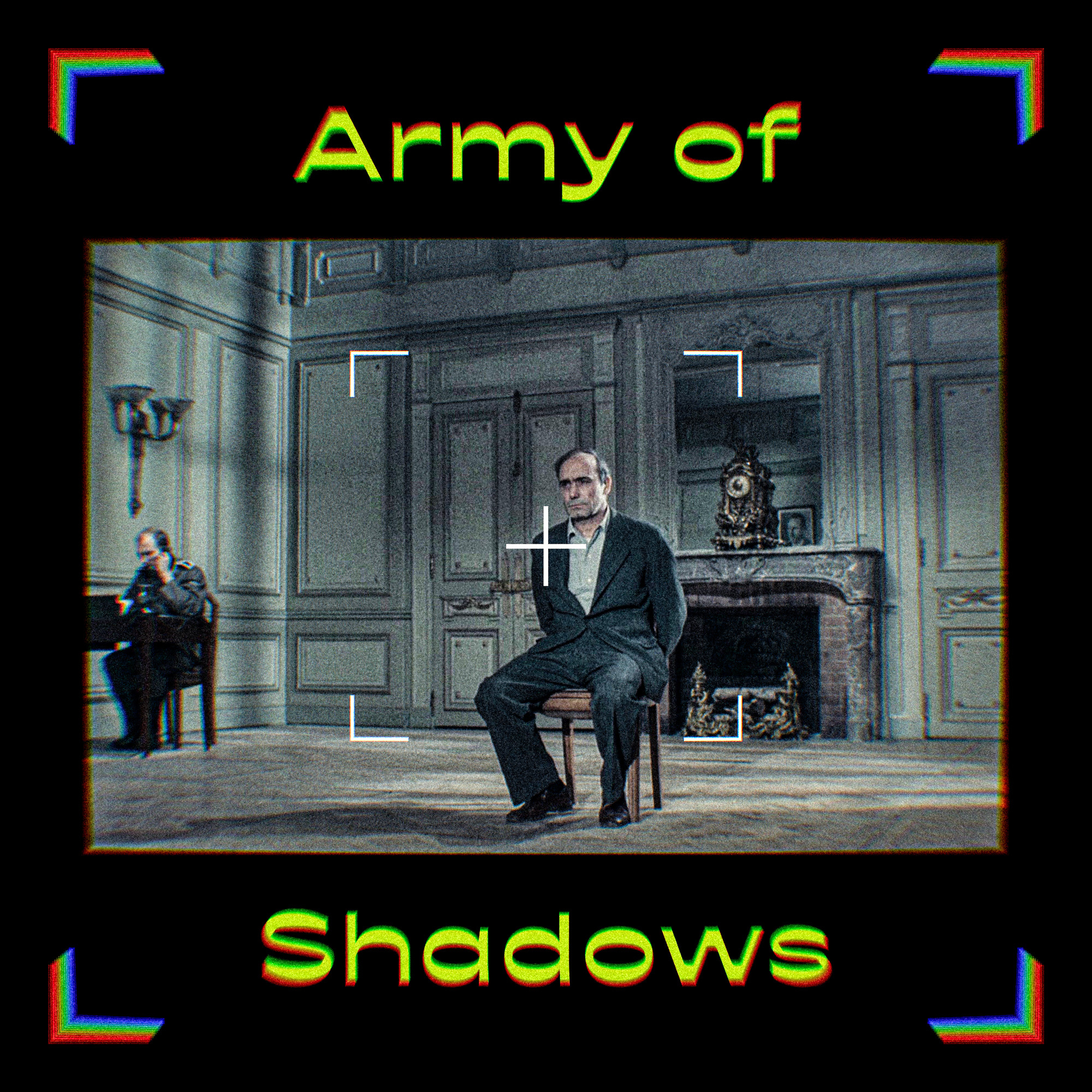
Van and Lyle are joined by film historian Matthew Ellis to revisit Jean-Pierre Melville’s Army of Shadows, a spare, rain-soaked chronicle of the French Resistance that refuses both triumph and sentimentality. From its opening march beneath the Arc de Triomphe—German boots echoing under imperial stone—to its epigraph welcoming “unhappy memories,” the film situates resistance not as romance but burden. Philippe Gerbier (Lino Ventura) moves through Vichy France like a man already half-absent, assembling a network of communists, aristocrats, schoolteachers, barbers, and couriers whose patriotism is less theatrical than procedural. The roll call of prisoners, the Phony War backdrop, the portrait of Himmler looming over interrogations, all of it underscores a world where power operates bluntly, but resistance must operate quietly.
Melville’s great subject is not sabotage but moral cost. The execution of the traitor unfolds with excruciating hesitation: The gun too loud, the knife unavailable, the final strangling improvised and intimate. A young militant weeps. Cyanide capsules are distributed as standard equipment. “We’re not an insurance company,” one quips, since risk here is existential rather than actuarial. Torture is never shown, only its aftermath. Heroism is never declared, only endured. The barber who silently provides a disguise, the aristocratic “baron” who aids the republic he once opposed, Mathilde juggling clandestine logistics while raising children who know nothing of her work… these gestures accumulate into something sturdier than spectacle. Even the attempted hospital rescue of Félix fizzles into grim realism. Often, nothing happens, and that nothing is the point.
The film resists easy sanctification. De Gaulle appears, medals are awarded, but Melville withholds catharsis. Gerbier writes to London, “I kid myself that I am still of some use,” surrounded only by the books of his mentor Luc Jardie. When Mathilde is arrested after the fatal mistake of carrying her daughter’s photograph, the movement faces its most devastating calculation. Loyalty demands cruelty. The final drive toward the Arc de Triomphe lands not as closure but as recurrence: Shadows defined by more shadows. Army of Shadows may be the definitive Resistance film, but it is also an anti-myth that is less about liberation than about what solidarity requires and what it destroys.
Further Reading
“Army of Shadows (1969)” by Brian Eggert
“Resistance is Futile” by Jonathan Rosenbaum
“Army of Shadows and Lacombe, Lucien”
Is Paris Burning? by Larry Collins and Dominique Lapierre
Teaser from the Episode
Army of Shadows Trailer


