


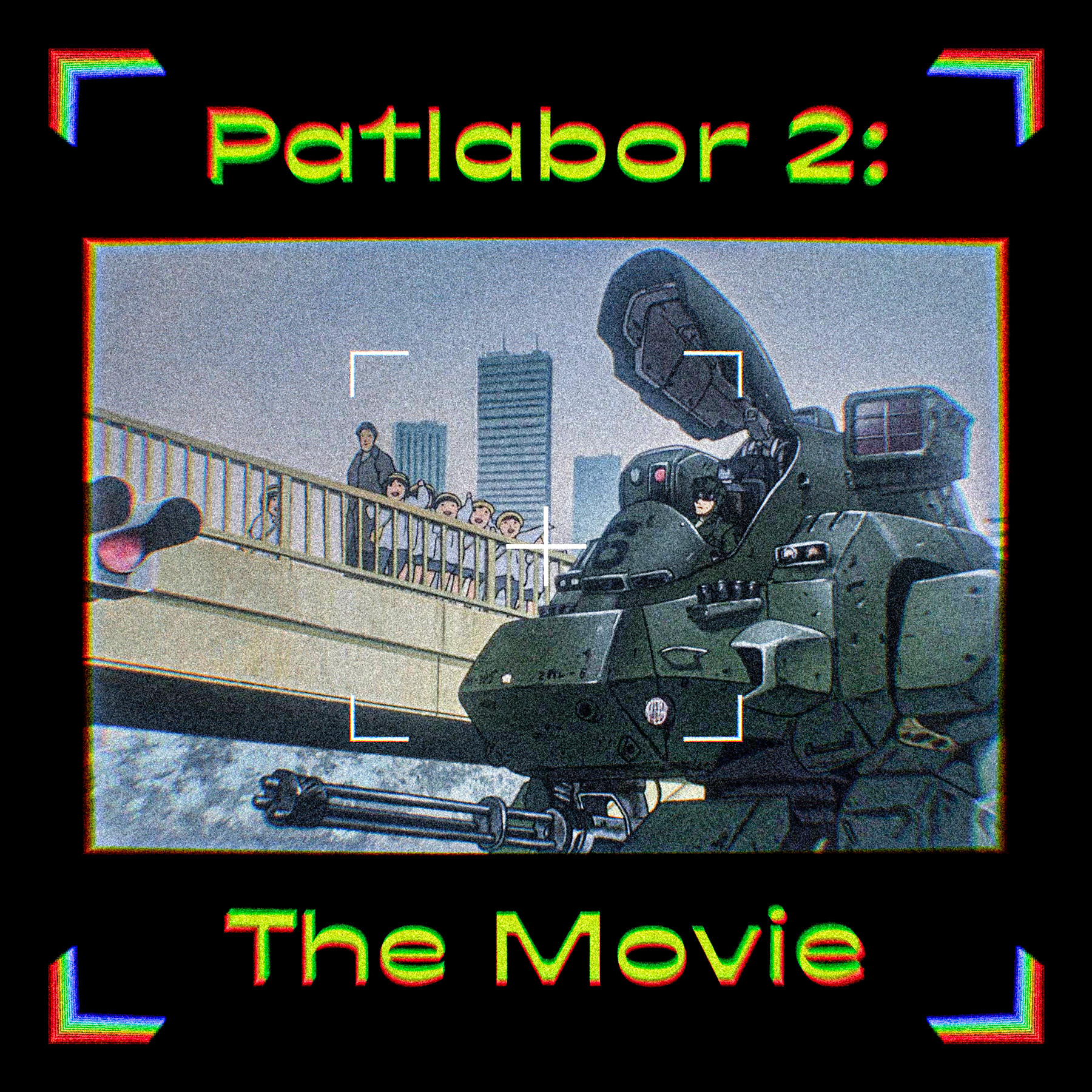
We’re joined by filmmaker and returning guest Kevin Fox to discuss Mamoru Oshii’s Patlabor 2, a film that masquerades as a techno-thriller before revealing itself as a bleak meditation on peace not as the absence of war, but as its managed disappearance from view. The opening scene sets the tone: A UN-led intervention force wielding advanced technology against a low-tech but effective guerrilla resistance. It’s a distant, managed conflict, war as something conducted elsewhere, on the periphery, in the name of order. When the film shifts back to Japan, that distance becomes the problem. This is a society organized around the belief that it exists outside of war altogether.
Oshii’s Tokyo is saturated with infrastructure, surveillance, and machines that promise security while obscuring responsibility. Decision-making rises higher and higher, until reality itself becomes inaccessible, filtered through procedures and abstractions. Throughout the film, animals and machines blur together: Aircraft framed like birds, birds clustering around military hardware, pigeons, crows, ducks, and scavengers moving through the city. The recurring blimps hover like omens, ambient and toxic. Technology doesn’t eliminate violence but anesthetizes it, making the moral consequences harder to see even as they become more pervasive.
At the center is Tsuge, a traumatized veteran whose experience of war has no place in a society committed to forgetting it ever happened. His grievance is not that Japan abandoned war, but that it outsourced and erased it, maintaining a false peace that depends on violence remaining invisible. Patlabor 2 flirts with reactionary conclusions while ultimately exposing their trap: Recognizing systemic hypocrisy does not justify bringing catastrophe home, but neither does denial prevent it. The film circles a biblical question—Cain and Abel, once a family—and refuses catharsis. Peace, Oshii suggests, is not the absence of war, but the alibi that allows it to continue unnoticed.
Further Reading
The Siege (1998) episode w/ Kevin
Bring the War Home by Kathleen Belew
The Cold War’s Killing Fields by Paul Thomas Chamberlin
War and Cinema by Paul Virilio
Dreamworld and Catastrophe by Susan Buck-Morss
PatLabor 2: The Movie Trailer


